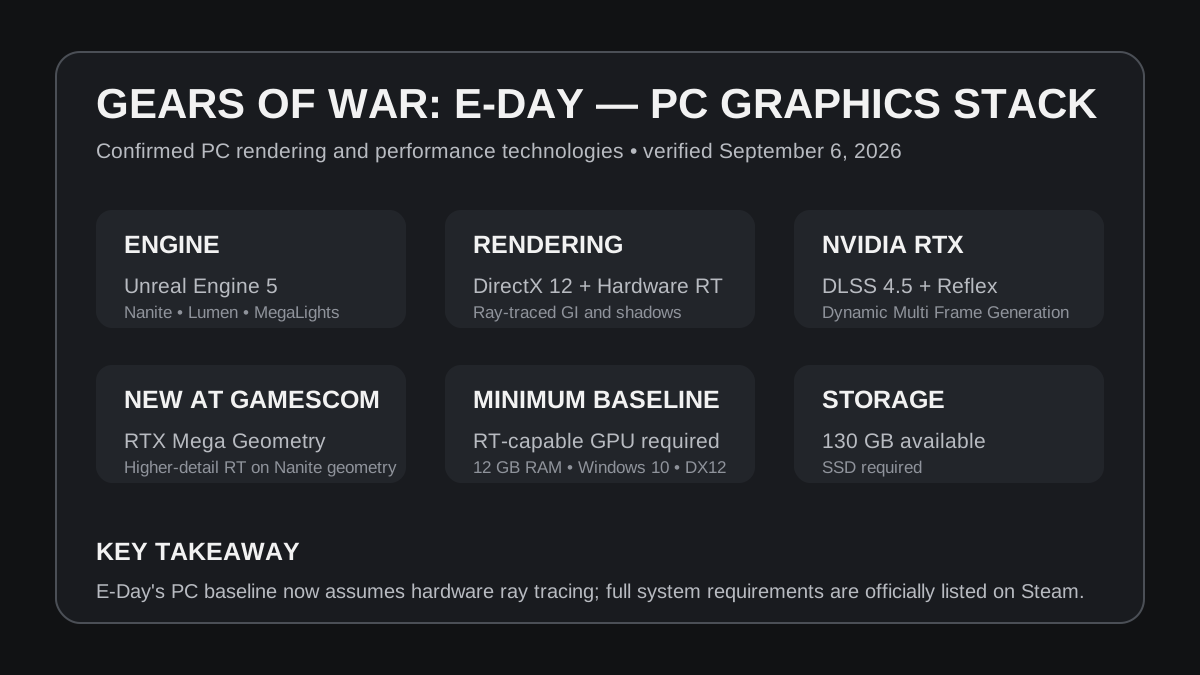
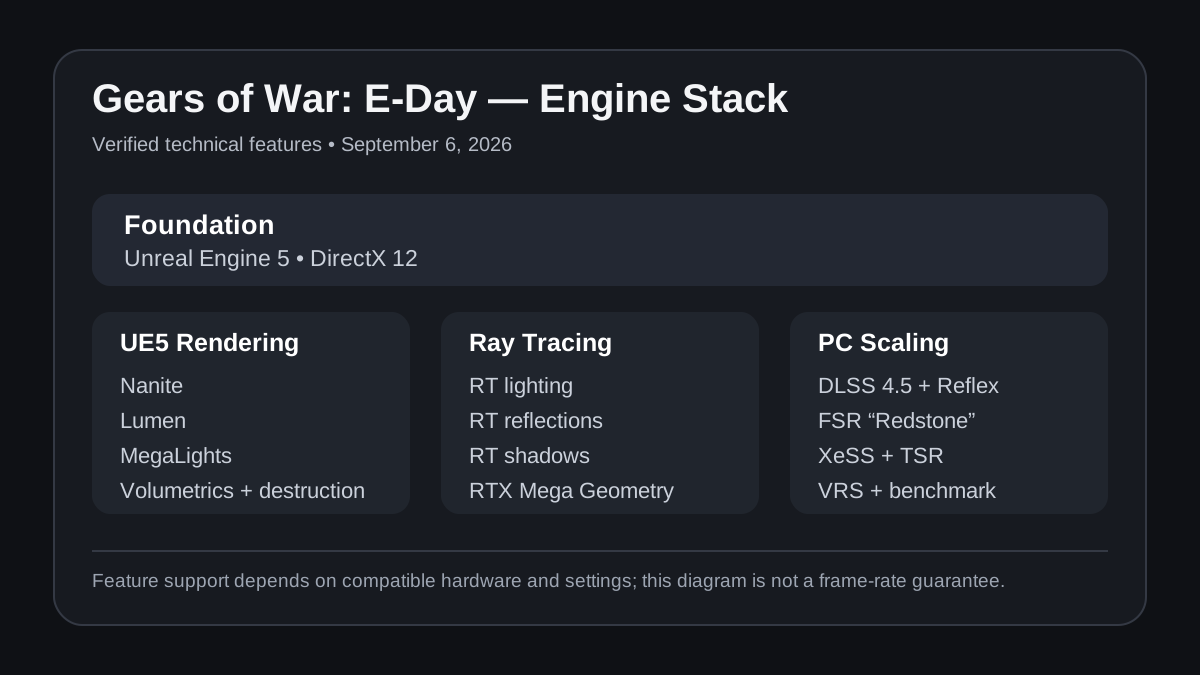
Gears of War: E-Day uses Unreal Engine 5 and DirectX 12, and the technical picture is now much more specific than it was earlier in 2026. The Coalition and its PC technology partner NVIDIA have confirmed that E-Day uses Nanite, Lumen, MegaLights, hardware ray tracing, and RTX Mega Geometry, alongside PC scaling technologies including DLSS 4.5, AMD FSR, Intel XeSS, Unreal Engine TSR, and NVIDIA Reflex.
That makes E-Day one of the clearest examples yet of The Coalition building a Gears game around Unreal Engine 5 rather than simply migrating an older rendering pipeline. It is still important to separate the engine from optional PC features: Unreal Engine 5 is the foundation of the game, while technologies such as DLSS, FSR, XeSS, Reflex, and RTX Mega Geometry depend on platform, GPU, settings, or storefront support.
What engine does Gears E-Day use?
The Gears E-Day engine is Unreal Engine 5. Xbox describes the game as built from the ground up in UE5, with DirectX 12 forming the PC graphics API foundation. NVIDIA's August technical material goes further and identifies specific Unreal Engine systems that E-Day is using in the playable build and final rendering stack.
The distinction is useful:
| Technology | Role in Gears E-Day |
|---|---|
| Unreal Engine 5 | Core game and rendering foundation |
| DirectX 12 | PC graphics API and path for modern rendering features |
| Nanite | Virtualized geometry system for much denser object detail |
| Lumen | Dynamic lighting system used for ray-traced global illumination and ambient occlusion |
| MegaLights | Handles large numbers of dynamic lights and ray-traced shadows |
| RTX Mega Geometry | NVIDIA technology that improves ray tracing of full-detail Nanite geometry on supported RTX hardware |
Earlier E-Day coverage correctly confirmed UE5 but did not yet have first-party confirmation for Nanite or Lumen. That is no longer the case. As of September 6, 2026, both systems are explicitly documented in NVIDIA's E-Day technical coverage, along with MegaLights.
How is Nanite used in Gears E-Day?
Nanite is Unreal Engine 5's virtualized geometry system. Its purpose is to let artists work with much denser geometry while the engine automatically manages how much detail needs to be rendered at a given distance.
NVIDIA says E-Day uses Nanite to increase object detail and fidelity by up to 100 times compared with Gears 5. That number comes from the technology partner's description of E-Day's content density; it should not be interpreted as saying every object contains exactly 100 times more polygons or that the whole game is literally 100 times more detailed.
The practical difference is visible in environments full of rubble, vehicles, foliage, debris, architecture, and small props. These are exactly the kinds of scenes E-Day needs because Kalona is being destroyed in real time during Emergence Day. A dense city environment benefits from being able to retain geometric detail without manually building the same old chain of traditional level-of-detail meshes for every asset.
Nanite also matters because of E-Day's new RTX Mega Geometry support. Standard ray tracing can use simplified geometry even while the rasterized object appears at higher Nanite detail. RTX Mega Geometry is designed to close that gap on supported GeForce RTX systems.
What is RTX Mega Geometry doing in E-Day?
At Gamescom 2026, NVIDIA announced that Gears of War: E-Day will debut RTX Mega Geometry. The feature is designed to make ray tracing work with substantially more detailed Nanite geometry rather than relying on a simplified representation of those objects.
That matters most for two visual effects:
- Ray-traced shadows can follow the shape of detailed objects more accurately.
- Ray-traced reflections can reflect the higher-detail version of Nanite objects instead of a much simpler proxy mesh.
NVIDIA's examples show improvements to details such as vehicle geometry, shopping-cart spokes, rocks, leaves, debris, cups, and other small objects. The point is not merely adding more geometry to the normal scene; it is giving the ray-tracing system access to more of that geometry so shadows and reflections match what the player actually sees.
RTX Mega Geometry is an NVIDIA RTX feature, not the definition of E-Day's engine. The game is still Unreal Engine 5 on all supported platforms. Mega Geometry is an additional rendering technology available on compatible GeForce RTX hardware.
How do Lumen and MegaLights work in Gears E-Day?
E-Day also uses two major Unreal Engine lighting technologies: Lumen and MegaLights.
NVIDIA describes Lumen as powering E-Day's ray-traced global illumination lighting and ambient occlusion shading. In practical terms, global illumination is concerned with how light bounces through an environment instead of treating every surface as if it is lit only by a direct lamp or sun source. For a game that moves through damaged streets, interiors, fires, emergency lighting, tunnels, and night scenes, that can have a major effect on atmosphere.
MegaLights addresses a different problem: handling many dynamic lights efficiently. NVIDIA says E-Day uses MegaLights for ray-traced shadows from up to 100 light sources in relevant scenes. That does not mean every room always contains 100 ray-traced lights. It means the rendering system is built to support highly light-dense environments without forcing the artists back to a much simpler lighting model.
These systems are especially relevant to E-Day's horror direction. The visual target relies heavily on emergency lights, darkness, muzzle flashes, fires, smoke, dust, explosions, and rapidly changing environments. A more dynamic lighting pipeline gives The Coalition more freedom to make those scenes react naturally as the player moves through them.
Does Gears E-Day have hardware ray tracing?
Yes. Hardware ray tracing is a confirmed PC requirement and graphics feature.
Steam's current system requirements explicitly say a hardware ray-tracing-capable GPU is required even at the minimum tier. The minimum list includes GPUs such as the GeForce RTX 2060 and Radeon RX 6600, while the recommended tier moves to hardware such as the RTX 3060 Ti / RTX 5060 or Radeon RX 6700 XT / RX 9060 XT.
The live Steam page also advertises hardware ray-traced lighting, reflections, and shadows. That is stronger evidence than an early technology preview because it is now part of the current storefront feature description and minimum hardware requirement.
For the exact CPU, GPU, RAM, Windows, and storage requirements, use the Gears E-Day system requirements guide.
DLSS 4.5, FSR, XeSS and TSR are not the engine
Upscaling and frame-generation technologies often get mixed into engine discussions, but they are separate layers.
E-Day supports several PC reconstruction choices:
- NVIDIA DLSS 4.5, including Super Resolution and Dynamic Multi Frame Generation on supported GeForce hardware.
- AMD FSR, with the current Steam listing specifically advertising FSR “Redstone.”
- Intel XeSS on compatible hardware.
- Unreal Engine TSR, Epic's engine-level temporal reconstruction option.
- NVIDIA Reflex for reducing system latency on supported hardware.
Steam also lists optional Frame Generation and Multi Frame Generation, Variable Rate Shading, and a built-in benchmark. These options make E-Day's PC version much more configurable than the phrase “built in Unreal Engine 5” alone would suggest.
A user choosing between DLSS, FSR, XeSS, or TSR should therefore base the decision on their GPU and the final image-quality/performance trade-off, not on the engine name. The available technology does not guarantee a specific FPS increase on every machine.
What about DLSS 4.5 Ray Reconstruction?
NVIDIA's Gamescom article announces full DLSS 4.5 support for E-Day and discusses its broader DLSS 4.5 technology stack. However, the clearest E-Day-specific claims in the current material are Super Resolution, Dynamic Multi Frame Generation, Reflex, ray tracing, and RTX Mega Geometry.
For that reason, it is safer to describe E-Day as having DLSS 4.5 support without promising that every DLSS 4.5 sub-feature or mode will be available under every GPU and graphics configuration. The final in-game graphics menu and launch-day driver will be the best source for mode-by-mode availability.
Does Unreal Engine 5 mean E-Day is open world?
No. An engine does not determine the structure of a game.
UE5 can support linear campaigns, hub-based games, open worlds, multiplayer maps, and many other designs. E-Day's campaign uses larger and more detailed environments, but that does not automatically make it an open-world Gears game. Engine features such as Nanite and Lumen are rendering systems, not evidence of a particular mission structure.
That distinction is important because screenshots of dense city spaces and modern UE5 technology can make the world appear larger than previous Gears environments. The campaign design still needs to be judged from campaign-specific information rather than from the rendering engine.
Real-time destruction, volumetrics, and larger set pieces
NVIDIA's August technical description also points to broader engine improvements beyond the headline lighting systems. It says E-Day uses new engine advancements for real-time destruction, widespread volumetric effects and particles, and larger explosive set pieces.
Those systems fit the game's setting particularly well. Emergence Day is not a clean battlefield after the fighting is over; it is a city collapsing while civilians and soldiers are still trying to understand what is happening. Destruction, smoke, dust, debris, fire, and particles are therefore part of the visual storytelling rather than just technical decoration.
Again, the important distinction is that these are capabilities of the final rendering and gameplay technology stack. They do not provide a benchmark by themselves. A visually complex set piece may place very different demands on a GPU and CPU than a smaller indoor encounter.
Does Gears E-Day run at 4K and 60 FPS?
Xbox's product information describes the game as built for 4K resolution and up to 60 FPS across Campaign and Multiplayer, with compatible hardware and display requirements.
The words “up to” matter. This should not be turned into a promise of native 4K at a locked 60 FPS in every scene, on every platform, or with every ray-tracing option enabled. PC performance in particular will depend on the CPU, GPU, graphics settings, selected reconstruction mode, ray-tracing configuration, frame generation support, and display.
Steam's built-in benchmark should make it easier for PC players to test a chosen configuration once the final game is available. Until then, the official system requirements provide a hardware floor and recommendation, but they do not publish resolution/FPS targets for each tier.
Is Gears E-Day using Unreal Engine 5.8?
NVIDIA's Gamescom technical article specifically refers to Unreal Engine 5.8's Lumen and MegaLights ray-tracing technologies while discussing Gears E-Day. Xbox's broader first-party marketing generally says simply Unreal Engine 5.
The useful takeaway is that E-Day is using the modern UE5 technology stack documented by the technical partner. For most players, the exact minor engine version matters much less than the confirmed systems: Nanite, Lumen, MegaLights, hardware ray tracing, and the PC scaling technologies described above.
Gears E-Day engine FAQ
What engine is Gears E-Day using?
Gears of War: E-Day is built in Unreal Engine 5 with DirectX 12 forming the PC graphics API foundation.
Are Nanite and Lumen confirmed?
Yes. They are now explicitly confirmed in NVIDIA's official E-Day technical coverage. Nanite increases geometric detail, while Lumen is used for ray-traced global illumination and ambient occlusion.
Does Gears E-Day use MegaLights?
Yes. NVIDIA says MegaLights powers performant ray-traced shadows from up to 100 light sources in relevant E-Day scenes.
What is RTX Mega Geometry?
RTX Mega Geometry is an NVIDIA technology debuting in E-Day that allows ray tracing to use substantially more detailed Nanite geometry, improving the accuracy of shadows and reflections on supported GeForce RTX hardware.
Does Gears E-Day require ray tracing hardware on PC?
Yes. Steam's minimum requirements explicitly require a hardware ray-tracing-capable GPU.
Does E-Day support DLSS and FSR?
Yes. DLSS 4.5 is confirmed, and Steam currently lists AMD FSR “Redstone.” Xbox also confirms Intel XeSS and Unreal Engine TSR as additional reconstruction options.
Is RTX Mega Geometry available on every GPU?
No. It is an NVIDIA RTX technology for compatible GeForce RTX hardware. Unreal Engine 5, Nanite, Lumen, and the game's underlying rendering foundation should not be confused with an NVIDIA-specific enhancement.
Bottom line
The answer to “what engine does Gears E-Day use?” is now much richer than simply “Unreal Engine 5.” E-Day combines UE5 and DirectX 12 with Nanite, Lumen, MegaLights, hardware ray tracing, real-time destruction, volumetric effects, and RTX Mega Geometry, while its PC version supports a broad set of scaling and latency technologies including DLSS 4.5, FSR, XeSS, TSR, and Reflex.
The important change since the earlier version of this guide is that Nanite, Lumen, and MegaLights are no longer speculative. They are explicitly confirmed. What remains variable is performance: the presence of these technologies does not guarantee a specific resolution or frame rate on every system, which is why the official requirements and the final built-in benchmark matter more than engine marketing alone.